Laundry Enzyme Troubleshooting for Detergent Product Managers
Industrial laundry detergents are judged in the wash aisle, not in the brochure. When a customer reports grey whites, persistent food stains, oily redeposition, odor carryover, or fabric harshness, the formulation question is direct: which enzyme class can help, and what formulation conditions may be limiting performance?
SoilVector supports laundry chemical manufacturers selecting enzyme ingredients for differentiated industrial detergents, boosters, prespotters, and additive systems. This guide connects common field observations to enzyme categories, wash-condition variables, and scale-up checks for product managers building or revising industrial laundry portfolios.
Primary use case: enzyme supplier for industrial laundry chemicals seeking practical guidance on ingredient selection and troubleshooting.
Start with the observed failure mode
Enzyme troubleshooting works best when it begins with the customer’s visible problem, not a generic ingredient list. The same wash complaint can come from soil type, alkalinity, surfactant balance, builder system, bleach exposure, temperature profile, or residence time.
Use the table below to narrow the first enzyme hypothesis.
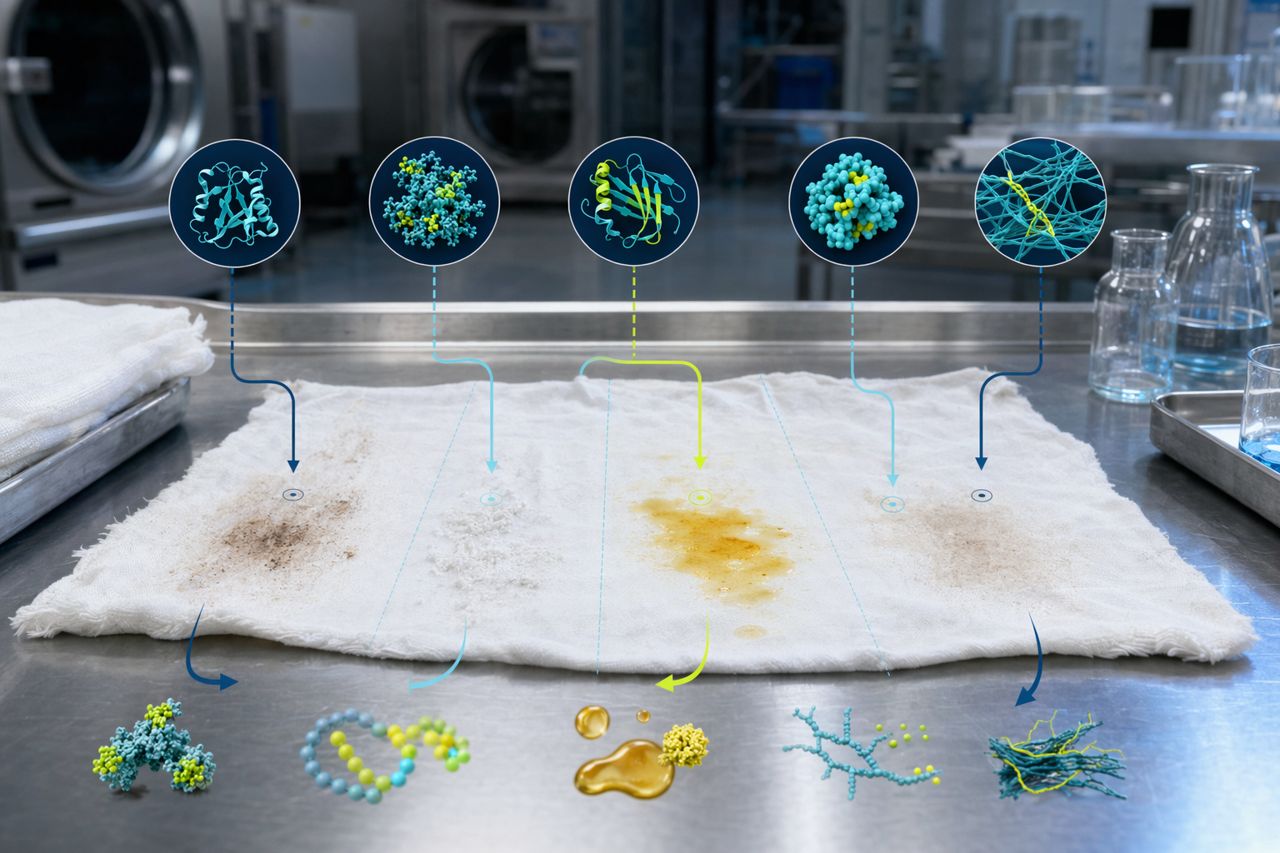
| Observed laundry issue | Likely soil or fabric factor | Enzyme categories to evaluate | Formulation focus |
|---|---|---|---|
| Blood, egg, dairy, sweat, cuff soil, collar soil remain visible | Protein-rich stains and body soils | Protease | Detergency system, alkalinity, bleach compatibility, storage stability |
| Pasta, sauces, gravy, baby food, starch haze | Starch-based binders trapping pigments and oils | Amylase | Low-temperature wash performance, surfactant release, redeposition control |
| Grease shadows, kitchen oil, sebum, towel rancidity | Lipid soils and fatty residues | Lipase | Surfactant package, emulsification, odor control, wash temperature |
| Dull cotton, greying, lint attachment, surface fuzz | Damaged cotton surface and particulate retention | Cellulase | Fabric care positioning, shade impact, controlled surface renewal |
| Chocolate, ice cream, gums, sauces with stabilizers | Galactomannan thickeners and mixed food soils | Mannanase | Combination detergent systems, food-service laundry, hospitality stains |
| Fruit, vegetable, wine, jam, cosmetic residues | Pectin-containing stains and plant-derived residues | Pectinase | Food and hospitality applications, stain-release boosters |
Troubleshooting by enzyme class
Protease: when protein soils anchor the stain
Protease is often the first enzyme class considered for industrial laundry because many high-visibility stains contain protein. It can improve removal of body soils, food residues, and proteinaceous binders that hold pigment or grease to fabric.
Evaluate protease when customers report:
- Collar and cuff soil after normal wash programs
- Sweat-related staining and odor retention
- Blood, egg, dairy, or meat-processing residues
- Inconsistent results on healthcare, hospitality, or food-service linen
Formulation checks:
- Is the enzyme protected from oxidizing components during storage?
- Does the pH profile support the chosen protease across the wash program?
- Are surfactants helping lift released soil, or allowing redeposition?
- Is the detergent designed for the customer’s actual temperature range?
Commercial note: Protease can support a strong value proposition for lower-temperature washing, reduced rewash, and broader stain coverage, but it should be positioned with realistic compatibility boundaries.
Amylase: when starch films trap dirt
Starch can behave like an invisible adhesive. It binds food particles, pigments, and oils to fabric, especially in institutional laundry streams with table linen, workwear, and food-service textiles.
Evaluate amylase when customers report:
- Starchy food stains after washing
- Grey or yellow haze on table linen
- Sauce and gravy residues that improve only with hotter programs
- Poor stain release despite adequate surfactant level
Formulation checks:
- Does the detergent need better performance in short or cooler cycles?
- Are builders and dispersants preventing released starch fragments from redepositing?
- Is the enzyme stable in the chosen liquid or powder format?
- Will the claim be stain-specific or part of a multi-enzyme performance system?
Commercial note: Amylase is useful when a product line targets hospitality, food-service, institutional, or workwear laundering where starch-based soils are recurring.
Lipase: when oils survive the wash
Oily soils can remain as shadows, malodor sources, or hydrophobic films. Lipase can help break down triglyceride soils and improve release of sebum, kitchen grease, and fatty residues.
Evaluate lipase when customers report:
- Grease shadows on workwear or table linen
- Persistent towel odor after washing
- Sebum build-up on collars, cuffs, and pillowcases
- Poor performance on kitchen, spa, or food-processing textiles
Formulation checks:
- Is the surfactant system strong enough to remove released oily fragments?
- Does the wash program provide suitable contact time?
- Are fragrance and odor-control claims aligned with actual soil removal?
- Is the enzyme stable in the finished detergent during distribution and storage?
Commercial note: Lipase is most compelling when paired with a clear oily-soil proposition and a surfactant system designed for emulsification, not just stain loosening.
Cellulase: when fabric surface condition drives appearance
Not every laundry performance problem is a stain problem. Cotton fabric surfaces can retain lint, particulate soil, and loose microfibrils that reduce brightness and softness. Cellulase can support controlled surface cleaning and fabric appearance benefits.
Evaluate cellulase when customers report:
- Dull cotton after repeated laundering
- Lint attachment and surface fuzz
- Reduced brightness on cotton-rich textiles
- Harsh hand-feel in institutional cotton programs
Formulation checks:
- Is the target fabric cotton or cotton-rich?
- Is shade preservation important for colored textiles?
- Is the product positioned for cleaning, fabric care, or both?
- Does the detergent format maintain enzyme integrity through shelf life?
Commercial note: Cellulase can help differentiate premium industrial laundry products, but it requires careful positioning around fabric type, dosage strategy, and appearance outcomes.
Mannanase and pectinase: when food thickeners and plant residues complicate stains
Modern food soils often contain stabilizers, gums, fruit solids, and vegetable residues. These components can make stains more persistent and can reduce the effectiveness of surfactants alone.
Evaluate mannanase when customers report:
- Chocolate, ice cream, sauce, and dressing residues
- Food-service stains with gum-based thickeners
- Mixed stains that remain after protein and starch optimization
Evaluate pectinase when customers report:
- Fruit, jam, vegetable, wine, or juice residues
- Hospitality stains involving plant-derived materials
- Stain shadows linked to natural thickeners or plant cell-wall components
Formulation checks:
- Is the product intended for hospitality, restaurants, food manufacturing, or institutional linen?
- Will the enzyme be used in a detergent, booster, or prespotter?
- Does the rest of the formula allow the enzyme to act before aggressive chemistry dominates?
Commercial note: Specialty carbohydrases can make a multi-enzyme detergent more relevant for real mixed-soil environments.
Match enzyme selection to detergent format
The right enzyme class still needs the right delivery context. SoilVector helps product managers evaluate enzyme fit across common industrial laundry chemical formats.
Liquid detergents
Liquid formats demand close attention to enzyme stability, water activity, pH, solvent selection, preservative system, and compatibility with surfactants and builders. Multi-enzyme liquids can be commercially attractive, but ingredient interactions should be screened early.
Powder detergents
Powder systems can provide a robust route for enzyme inclusion, particularly when segregation, coating, and moisture control are managed correctly. Product managers should consider dust control, blending sequence, storage conditions, and regional handling requirements.
Boosters and additives
Boosters allow more targeted enzyme positioning for customers with specific soil profiles. This can simplify reformulation, support premium wash programs, and create account-specific performance packages.
Prespotters
Prespotter systems may benefit from enzyme inclusion when contact time and fabric compatibility are well defined. Formulation should be aligned with the expected stain type and downstream wash chemistry.
Common formulation variables that limit enzyme performance
When an enzyme-containing detergent underperforms, the enzyme may not be the root cause. Review these variables before changing the ingredient strategy.
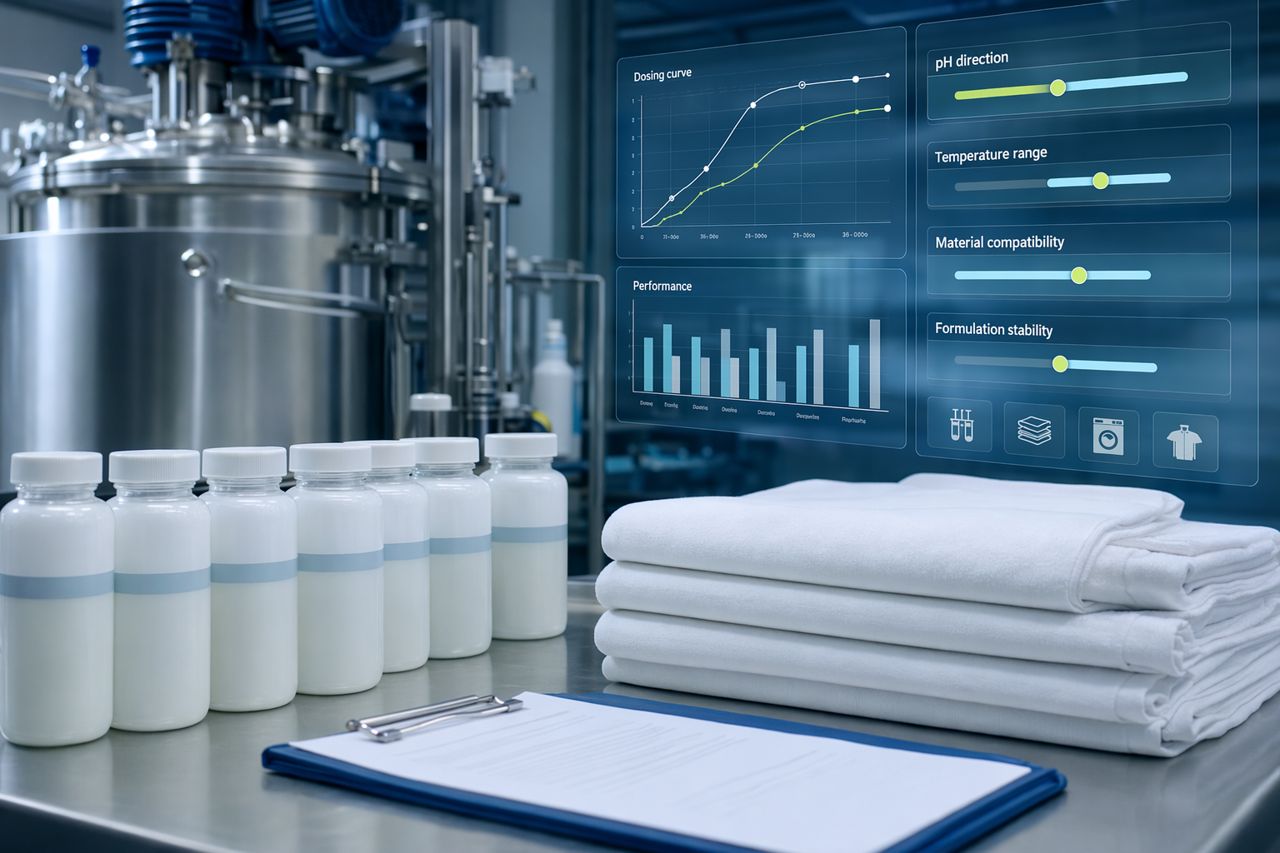
- pH profile: Is the wash environment aligned with the selected enzyme class?
- Temperature range: Does the enzyme support the customer’s real wash programs, including cooler cycles?
- Oxidizing chemistry: Is the enzyme exposed to bleach or oxidizers during storage or use?
- Surfactant balance: Are released soils being removed and suspended effectively?
- Builders and chelants: Is water hardness control supporting stain release?
- Contact time: Does the wash program give the enzyme enough opportunity to work?
- Detergent format: Is the enzyme stable in the finished product through manufacturing, shipment, and storage?
- Soil mix: Is the target stain mainly protein, starch, lipid, cellulose-associated, gum-based, or plant-derived?
A practical troubleshooting workflow
Use this sequence when a customer complaint points toward enzyme performance.
- Define the textile stream. Hospitality linen, healthcare textiles, kitchen workwear, food-processing garments, mats, towels, and cotton-rich goods each create different soil pressure.
- Capture the wash conditions. Temperature, pH, cycle time, liquor ratio, hardness control, bleach stage, and detergent format all affect enzyme selection.
- Identify the dominant soil family. Protein, starch, lipid, gum, pectin, and cotton-surface issues call for different enzyme classes.
- Review formula compatibility. Check surfactants, builders, solvents, preservatives, oxidizers, and storage expectations.
- Select a focused enzyme shortlist. Avoid overcomplicating the first screen. Start with the most relevant class or class combination.
- Run application-relevant wash comparisons. Compare against the existing formula under customer-like conditions.
- Confirm manufacturing fit. Validate blending order, handling requirements, stability expectations, and packaging compatibility.
- Build the claim carefully. Translate performance into buyer-relevant outcomes such as rewash reduction, low-temperature performance, improved stain breadth, fabric appearance, or program simplification.
Enzyme combinations for differentiated laundry products
Single-enzyme systems can solve focused problems. Multi-enzyme systems can support broader stain coverage, especially for industrial laundry accounts with mixed soils.
Common combination strategies include:
- Protease + amylase for food and body soil coverage
- Protease + lipase for sebum, protein, and greasy workwear residues
- Protease + amylase + lipase for broad institutional and hospitality detergents
- Cellulase + stain enzymes for cleaning plus cotton appearance support
- Mannanase or pectinase additions for food-service and hospitality stain complexity
The best combination depends on the target account, detergent format, cost-in-use target, and compatibility envelope. SoilVector can help narrow the ingredient set before pilot production.
What to prepare before requesting an enzyme quote
To support a relevant recommendation, share the commercial and technical context behind the product.
Useful information includes:
- Target detergent or additive format
- Intended application: hospitality, healthcare, food service, workwear, institutional, or mixed laundry
- Key stains or customer complaints
- Approximate wash temperature range and pH direction
- Presence of bleach, oxidizers, solvents, or high-alkaline components
- Liquid or powder processing route
- Desired positioning: low-temperature cleaning, stain breadth, fabric brightness, odor control, premium additive, or account-specific booster
- Target launch timeline and expected supply scale
We do not need proprietary full formulas to begin. A structured performance brief is enough to identify relevant enzyme categories and quotation options.
Request a quote for laundry enzyme ingredients
If you are developing or reformulating an industrial laundry detergent, booster, or prespotter, SoilVector can help connect observed wash problems to practical enzyme ingredient options.
Request a quote through the on-site form and include your target application, detergent format, main stain issues, and expected scale. We will respond with a focused recommendation path for your laundry chemical program.