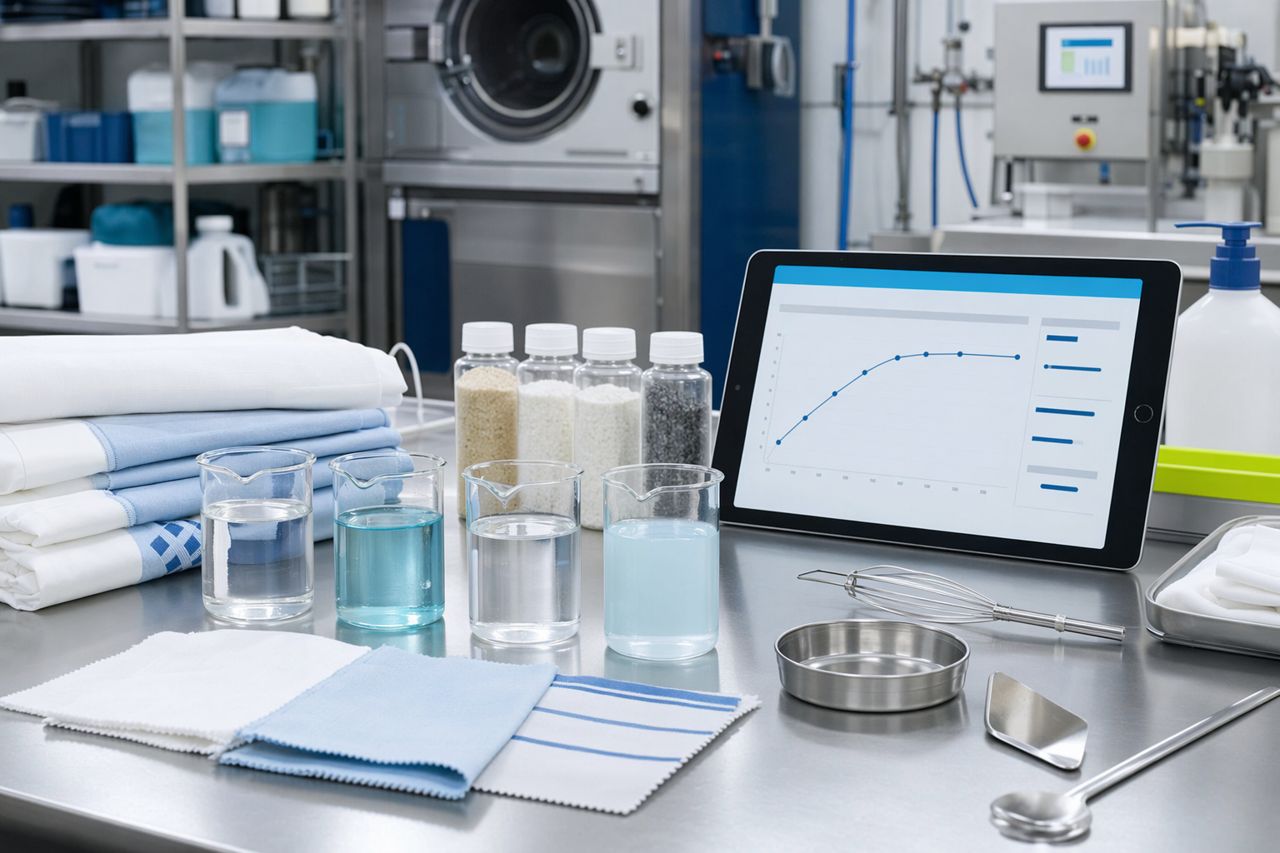
Enzyme ingredients for healthcare linen detergent manufacturers
Hospital and healthcare linen programs place unusual pressure on industrial laundry chemistry. Loads can include protein-heavy soils, body oils, starch residues, ointments, food soils, and repeated exposure to alkaline builders, surfactants, and oxidizing systems. For chemical manufacturers, the challenge is not simply adding an enzyme. It is selecting enzyme classes that hold up in the real wash environment and support a differentiated finished detergent or additive.
Enzymimpact is a wholesale enzyme supplier for laundry chemical manufacturers and distributors serving healthcare linen. We quote protease, lipase, amylase and blend options for bulk production and help technical teams build enzyme systems for healthcare linen detergents, pre-spotters, boosters and wash additives.
This page discusses enzyme ingredient selection for hospital and healthcare linen applications. It does not make disinfection, sanitization, antimicrobial, or regulatory treatment claims.
Where enzymes create value in healthcare linen programs
Healthcare linen soils are mixed, aged, and often processed under tight cycle economics. Enzymes can help manufacturers improve performance in areas that are difficult to address with builders and surfactants alone.
Protein-heavy soils
Protease ingredients are commonly selected for protein-based residues found on sheets, gowns, towels, patient apparel, and reusable textile items. In a healthcare linen detergent, the right protease profile can support:
- Better removal of proteinaceous soil films
- Reduced dependence on very aggressive wash conditions
- More consistent performance across mixed linen streams
- Improved clean appearance after repeated processing
For formulators, protease selection should consider wash pH, temperature window, surfactant system, builder package, and expected contact time in the main wash or pre-wash step.
Body oils, sebum, and ointment residues
Lipase ingredients can support breakdown of fatty soils, including body oils and certain greasy residues. In industrial healthcare laundry, these soils may bind to cotton-rich textiles and polyester blends, contributing to graying, odor retention, and dull appearance over repeated wash cycles.
Enzymimpact helps manufacturers evaluate lipase fit against surfactant choice, alkalinity, emulsification strategy, and product format so the enzyme contributes to a stable and commercially usable formulation.
Starch and food-related residues
Amylase ingredients are useful where starch-based soils are part of the load profile, including food residues, thickeners, and certain care-environment soils. Amylase can improve release of starch films that otherwise trap particulate soil and interfere with brightness.
For healthcare laundry products, amylase is often considered as part of a multi-enzyme system rather than as a standalone performance lever.
Textile appearance and brightness maintenance
Cellulase ingredients may be used selectively for cotton-containing textiles where surface fiber management is desired. In the right formulation context, cellulase can support appearance maintenance by helping reduce microfibril-related dullness and soil redeposition effects.
Because healthcare linen must tolerate repeated industrial processing, cellulase selection requires care. Enzymimpact supports enzyme class choice around fabric type, wash severity, end-use requirements, and compatibility with the total detergent system.

Enzyme class selection by formulation objective
| Formulation objective | Enzyme class to evaluate | Practical selection factors |
|---|---|---|
| Protein soil release | Protease | pH tolerance, surfactant compatibility, alkaline stability, storage profile |
| Fatty soil and sebum removal | Lipase | emulsification strategy, builder system, wash temperature, liquid or powder format |
| Starch residue removal | Amylase | mixed-soil performance, alkaline fit, compatibility with protease systems |
| Cotton appearance support | Cellulase | textile type, wash severity, dosing strategy, fabric care positioning |
| Multi-soil performance | Blended enzyme systems | enzyme-enzyme compatibility, product format, supply consistency, scale-up support |
Built for detergent and additive manufacturers
Enzymimpact does not approach healthcare laundry as a generic enzyme sale. We support industrial laundry chemical suppliers with ingredient decisions that connect to finished product strategy.
We help define the enzyme role
Before recommending an enzyme ingredient, we look at the intended product format and performance target:
- Main wash detergent
- Alkaline detergent builder with enzyme compatibility needs
- Enzyme booster
- Pre-wash or soak additive
- Stain removal support product
- Low-temperature or energy-conscious wash program component
- Premium healthcare linen formula with multi-soil positioning
The goal is to avoid overbuilding the enzyme package and instead place the right enzyme class where it provides measurable formulation value.
We consider wash conditions early
Hospital and healthcare linen formulas may face wide operating windows. Enzyme fit depends on more than soil type. Key formulation questions include:
- Is the product liquid, powder, granule, or soluble-pack compatible?
- What pH range will the enzyme see during storage and wash use?
- Will oxidizers be present in the same product or dosed separately?
- Are nonionic, anionic, or amphoteric surfactants dominant?
- Is the formula designed for low-temperature, moderate-temperature, or hotter wash programs?
- Does the product need long shelf stability in concentrated form?
- Are chelants, builders, solvents, or preservatives part of the system?
These questions shape enzyme format, stabilizer strategy, blend design, and supply specification.
How protease activity is checked before you buy
Manufacturers quantify alkaline protease activity in enzyme preparations, fermentation broths and production samples with an assay run at alkaline pH on a casein substrate, the reference for checking quality and tuning production.
The optimum in that assay sits at the alkaline end of the range, which is why alkaline protease is the class matched to alkaline builder systems in linen detergents.
For a buyer, the practical point is that an activity figure only means something with its method: compare grades from different suppliers on the same assay conditions, not on the headline number.
| What to ask the supplier | Why it matters |
|---|---|
| The assay method behind the stated activity | Activity is measured under defined alkaline conditions on casein |
| Whether all quoted grades use the same method | Figures from different assays cannot be compared |
| Batch-to-batch activity checks | The same assay is used to check preparations and production samples |
Mistakes to avoid when comparing quotes:
- Choosing the grade with the highest activity number without asking how it was measured.
- Assuming a neutral protease grade will behave like an alkaline one in a high-pH linen detergent.
Compatibility considerations for healthcare linen enzyme systems
Alkalinity and builder packages
Many industrial laundry detergents use alkaline conditions to improve soil removal. Enzyme selection should match the intended pH exposure so performance is not lost before the enzyme has time to contribute. Enzymimpact can help evaluate protease, amylase, lipase, and cellulase options that align with alkaline builder systems.
Surfactant interaction
Surfactants drive wetting, emulsification, and soil suspension. They can also affect enzyme behavior. Enzymimpact supports compatibility review across common industrial laundry surfactant systems so enzyme ingredients are selected for the actual finished formulation, not an isolated bench condition.
Oxidizing systems and separation strategy
Healthcare linen programs may use oxidizing components as part of the overall wash process. Enzymes and oxidizers are often best managed through separation, staged dosing, encapsulation, or formula architecture rather than direct co-storage in a highly reactive environment. We help manufacturers think through practical routes without making antimicrobial or regulatory claims.
Product format and storage stability
Enzyme format matters. A powder detergent, liquid concentrate, booster, and two-part system each create different stability requirements. Enzymimpact can supply and help evaluate enzyme formats suitable for industrial formulation development, including options designed for easier handling, blending, and scale-up.
Differentiation opportunities for industrial laundry chemical suppliers
A well-designed enzyme system can help a laundry chemical manufacturer create clearer product positioning, including:
- Protein and body-soil focused healthcare linen detergents
- Low-temperature performance formulas for energy-conscious laundering
- Multi-enzyme boosters for mixed hospital soil loads
- Textile brightness and appearance support additives
- Formulas designed for repeated laundering of cotton-rich and blended linens
- Programs that balance performance with cycle efficiency and substrate care
The commercial value is practical: better performance stories for sales teams, more defensible formulation architecture, and a clearer path from development sample to production supply.
Scale-up support from sample to supply
Product managers need enzyme ingredients that can move beyond screening. Enzymimpact supports the development path with:
- Enzyme class selection based on soil profile and wash design
- Format guidance for powders, liquids, concentrates, and boosters
- Compatibility discussion for builders, surfactants, chelants, solvents, and oxidizing systems
- Blend strategy for protease, lipase, amylase, and cellulase combinations
- Supply planning for pilot batches and commercial production
- Documentation support appropriate for B2B ingredient qualification
We keep the conversation focused on formulation outcomes, substrate compatibility, and manufacturing practicality.
Request a quote for healthcare linen enzyme ingredients
If you manufacture industrial laundry detergents or additives for hospital and healthcare linen programs, Enzymimpact can help you select enzyme ingredients that match your soil targets, wash conditions, and product format.
Use the on-site request a quote form to tell us about your application, desired product format, target wash conditions, and enzyme classes under consideration. A Enzymimpact technical representative will respond with ingredient options and next-step guidance.
What to send with your inquiry: the product or enzyme class you need, the quantity per order or per year, the destination country, and your detergent format (liquid, powder, booster or presoak). Pricing, pack sizes and lead times are quoted per order.